Category: Blog

Precision Medicine Is Coming

On January 20, 2015, in his State of the Union Address, President Obama launched a new Precision Medicine Initiative. This research initiative is a bold new effort to improve how we treat disease and how we cure diseases like cancer and diabetes. The Precision Medicine Initiative will pioneer a new model of patient-powered research that aims to accelerate biomedical discoveries and provide clinicians with new tools, knowledge, and therapies to select which treatments will work best for which patients. Personalized medicine is often described as providing “the right patient with the right drug at the right dose at the right time.”

Currently, medical practitioners follow a trial-and-error approach when treating patients. In other words, if a patient has a disease, his or her doctor will prescribe a treatment plan based on general information, and re-assess after a few weeks. If the treatment is not working, the doctor will change some variable in the plan, and wait a few more weeks to see if there is any improvement. This approach can lead to patient dissatisfaction, adverse drug responses and interactions, and poor adherence to treatment regimens by the patient. While this may seem bleak, there have been rapid developments in a variety of medical fields like genomics, medical imaging, and computational biology that are making it possible for scientists and doctors to personalize diagnosis and treatment of diseases. Precision medicine gives clinicians tools to better understand the complex mechanisms underlying a patient’s health, disease, or condition, and to better predict which treatments will be most effective. I believe the Precision Medicine Initiative is just what is needed to continue encouraging creative approaches to precision medicine and build the evidence base necessary to guide clinical practices.

The main objectives of this initiative are:

  • An increase in better cancer treatments: The National Cancer Institute (NCI) will accelerate the design and testing of effective, tailored treatments for cancer by expanding genetically based clinical cancer trials, exploring fundamental aspects of cancer biology, and establishing a national “cancer knowledge network,” that will generate and share new knowledge to fuel scientific discovery and guide treatment decisions.
  • Creation of a voluntary national research cohort: The National Institute of Health (NIH), in collaboration with other agencies and stakeholders, will launch a national, patient-powered research cohort of one million or more Americans who volunteer to participate in research. Participants will be involved in the design of the initiative and will have the opportunity to contribute diverse sources of data – including (but not limited to) medical records, profiles of patient genes, chemical makeup, and environmental and lifestyle data.
  • Commitment to protecting privacy: The White House will launch a multi-stakeholder process with Health and Human Services (HHS) and other Federal agencies to solicit input from patient groups, bioethicists, privacy and civil liberties advocates, technologists, and other experts to identify and address any legal and technical issues related to the privacy and security of patient data.
  • Regulatory modernization: The Initiative will review the current regulatory landscape and work with the Food and Drug Administration (FDA) to determine whether changes are needed to support the development of this new research and care model.
  • Public-private partnerships: The Obama Administration will forge strong partnerships with existing research cohorts, patient groups, and the private sector to develop the infrastructure that will be needed to expand cancer genomics, and to launch a voluntary million-person cohort.

Key Investments to Launch the Precision Medicine Initiative:

  1. $130 million to NIH
  2. $70 million to NCI
  3. $10 million to FDA
  4. $5 million to The Office of the National Coordinator for Health Information Technology (ONC)

In sum, the Precision Medicine Initiative is a great endeavor and its greatest benefits will likely be seen many years in the future. However, this initiative will revolutionize the practice of medicine, and give patients a better chance at good health than they have ever had.
 

Herbal Supplement Industry Under Fire

On February 3, the New York State Attorney General’s Office accused four major retailers of selling fraudulent and potentially dangerous herbal supplements, demanding that they cease the sale of these products. Law enforcement officials investigated herbal supplements sold at GNC, Target, Walgreens and Wal-Mart. The investigation found that four out of five products tested did not contain any of the herbs on their labels. The pills only contained cheap fillers like powdered rice, asparagus, and houseplants. In some cases, the supplements consisted of common allergens, such as wheat-products.

Health experts welcomed the investigation, having long complained about the quality and safety of dietary supplements. The Dietary Supplement Health and Education Act (DSHEA) of 1994 exempts substances from the requirements to demonstrate safety and effectiveness and from the Food and Drug Administration’s (FDA) pre-market approval. In contrast, the European Union regulates dietary supplements and requires a demonstration of safety before they can be sold. On the other hand, the FDA strictly regulates pharmaceuticals. Under 21 U.S.C. § 355, a provision of the Federal Food, Drug, and Cosmetic Act, the FDA requires that new drugs demonstrate safety and effectiveness through scientific evidence before receiving market approval.

In the past, the FDA has issued warning letters to manufacturers of dangerous supplements requiring them to either change the recipe of their supplement or remove their product from the market. In the majority of these cases, the FDA has received several reports of adverse events from consumers. For example, in November 2014, the FDA issued a warning letter to V26 Slimming Coffee because it contained sibutramine, a controlled substance that was removed from the market in October 2010 for safety reasons. Consumers may look at the FDA’s Consumer Updates web site for updates on recalls and alerts. However, this move by the New York State Attorney General’s Office is the first time a law enforcement agency has threatened the biggest retail and drugstore chains with legal action for selling “deliberately misleading herbal products.”

Some of the investigation’s findings at these retailers included:

  1. Walgreens: store brand of ginseng pills contained only powdered garlic and rice;
  2. Walmart: ginkgo biloba contained no ginkgo biloba, but radish, wheat, rice, and mustard;
  3. Target: six herbal products tested negative for the herbs on their labels but did contain powdered rice, beans, peas and wild carrots; and,
  4. GNC: pills contained unlisted ingredients used as fillers like powdered peanuts and soybeans.

Regulating supplements has been hotly debated in Congress. Senator Orrin Hatch (R-UT), the sponsor of DSHEA, has successfully opposed potential amendments that would require supplement makers to register their products with the FDA. In 2013, Senators Richard Blumenthal (D-CT) and Richard Durbin (D-IL) introduced the Dietary Supplement Labeling Act, which would require dietary supplement manufacturers to register their products with the FDA and to disclose known risks of any ingredients on their labels. However, this bill remains in the Committee on Health, Education, Labor, and Pensions (HELP).

Industry representatives dispute the testing methods used in the investigation, arguing that only a handful of fringe companies have caused these problems. However, New York’s investigations targeted store generic brands at national drugstores and retail giants, suggesting that these problems are pervasive and extensive. Dr. Pieter Cohen, an assistant professor at Harvard Medical School and an expert on supplement safety, stated, “If this data is accurate, then it is an unbelievably devastating indictment of the industry.”

Currently, tests are being conducted to confirm the results of New York’s investigation. Until the results are released, the debate continues. Consumers should be wary that the supplements they are taking may not contain the ingredient listed on their labels. James Hamblin, a physician and senior editor at The Atlantic, notes that even if these supplements do not contain their listed ingredients, there may be a legitimate placebo effect to taking these supplements. However, it is better for the public to know what’s in their supplements, rather than letting this “apparent institutionalized fraud” continue. Consumers have a right to know what is in their products, what they are putting in their bodies, and what they are spending their money on. The Dietary Supplement Labeling Act is a commendable step in the right direction, and the Senate HELP Committee should move it forward.


Warehouse fire highlights importance of EHR

A warehouse fire in the Williamsburg neighborhood of Brooklyn, NY provided yet another compelling argument for the need for protected health information to be accessible through an Electronic Health Record (EHR) system. The federal government, through the Department of Health and Human Services (HHS), among other entities, have released various statements highlighting the importance of developing EHRs. The fire, which burned a Williamsburg warehouse on January 31, 2015, resulted in innumerable pieces of personal health information (PHI) littering the streets of New York. The fire, which began on a Saturday, still burned on Monday.

According to EHR Intelligence, “recovery specialists [continue to] comb the streets and the East River for fragments of papers with personal health information, social security numbers, and bank account details exposed to the public.” Moreover, EHR Intelligence reports that North Shore-Long Island Jewish Health System, New York-Presbyterian Hospital, NYU Langone Medical Center, and Mount Sinai Health System stored records and patient information at the warehouse. Luckily, all the organizations, according to the New York Times, had copies of the patient records within its respective EHR systems.

Fortunately with responsive recovery teams and on the ground personnel the warehouse fire did not result in a massive breach potentially affecting thousands of patients, but it did illustrate the importance of having effective EHR systems and also the need to store patient data in more than one place. Imagine if any of the health care providers storing data at the warehouse did not have an EHR system. Could you imagine mitigating that situation? What would you tell patients? How would HHS deal with the breach?

The Office of the National Coordinator, within HHS, has numerous resources available to providers to help implement an effect EHR system. Moreover, the ONC provides additional information about the importance of EHR systems to improving patient care. Other than helping to reduce potential breaches, EHR systems are so popular because they help further the goal of interoperability. Interoperability is on the national health care agenda and has support from both Congress and the White House. President Obama’s proposed fiscal year 2016 budget allocates $78 million to ONC, which is a $17 million dollar increase since ONC’s inception, to help further the interoperability mission. Having an effective EHR system helps to promote the interoperability message in that, after the initial interoperable framework is laid by the federal government, it will be crucial for providers to be well equipped with systems that can easily interact with one another. EHR systems allow a patient with various providers to receive more coordinated care. Moreover, EHR systems can make it much less burdensome for individual patients to access their personal health records.

While the weekend warehouse fire is a tell tale example of the necessity for electronic record keeping, the federal government is also invested in the electronic systems to help further an even more important goal: increasing the quality and effectiveness of health care services.

State Politics, Medicaid Expansion, and Public Health

Since the Supreme Court ruled against the Affordable Care Act’s mandatory Medicaid expansion in 2012, twenty-nine states and the District of Columbia have expanded the program to individuals at or below 138% of the Federal Poverty Index (FPI), or approximately $16,000 for an individual per year. Resistance to the expansion has largely come from states with Republican governors and/or legislatures. However, in December, three GOP governors moved to expand Medicaid in their states – Utah, Tennessee, and Texas. Indiana received Federal approval for its Medicaid plan the last week in January. While a big move in support of the President’s signature health care law, the proposals come with drawbacks that may negatively affect the effectiveness of the expansion.

The Utah expansion does not rely on Federal programs to insure its citizens. Adapting the Arkansas expansion plan, the Utah plan allows the State’s citizens to purchase private insurance with Federal funds rather than enrolling in the Federal Medicaid program. Utah’s program will cover nearly 100,000 residents over the next four years. Residents under 100% FPI continue their enrollment in traditional Medicaid while the “expanded” individuals (between 100-138% FPI) receive assistance to purchase private insurance or enroll in an employer-offered plan. The Utah plan touts $15 monthly premiums. However, the plan also poses a $50 penalty for every Emergency Room visit for a non-emergency situation in an effort to bring down health care costs. Notably, this adapted Medicaid expansion had to be approved by the Centers for Medicaid and Medicare Services (CMS).

Tennessee liked the plan behind Utah’s expansion. Medicaid expansion under these terms has been deemed a compromise between Republican and Democratic ideals. Gov. Bill Haslam has specifically stated that his 2015 proposal is not an expansion of the Medicaid program, but the “unveil[ing] of Insure Tennessee.” Early estimates predict that nearly 200,000 Tennesseans will be eligible for State assistance under the proposed expansion. Notably, Tennessean hospitals are largely in favor of the Expansion. The Tennessee Expansion does more than focus solely on making available funds to purchase private insurance, but also shifts bill-payment to an outcome-based method rather than fee-for-service. Representatives in Tennessee on all sides of the Expansion debate support the Governor’s decision to make insurance available through the proposed means. The proposals must still be approved by the Tennessee legislature and CMS.

The biggest potential win for the President’s health law is the state of Texas. Former Governor Rick Perry has been one of the most vociferous opponents of the Medicaid expansion. However, Governor-Elect Greg Abbott addressed the extremely controversial topic with state lawmakers in Houston. Working with CMS to expand Medicare could mean nearly $10 billion in Federal funds for Texas over the coming years. Texas has the most of any state to gain from the Medicaid Expansion. Nearly 950,000 Texans live between 100-138% FPI. The Kaiser Foundation believes these Texans represent approximately twenty-five percent of all Americans living in the “gap.” The Texas legislature has rejected the “traditional” Expansion, but the Governor-Elect’s meetings may indicate an alternative similar to those in Utah and Tennessee, though his office has yet to comment.

The approval of Indiana’s plan may encourage even more states to expand their Medicaid services. The Indiana plans extends coverage to nearly 350,000 low-income individuals and families. The plan requires enrollees to contribute to a health savings account, an effort to keep “personal responsibility” as part of the expansion. However, the plan comes with high penalties for missed payments, including up to six-month exclusions from the program. The plan also increases reimbursement rates, which were cut across the board by the Affordable Care Act. Indiana’s plan has already caught the attention of the Wyoming legislature.

The twenty-two states that are yet to expand the Federal program need to act quickly. The Affordable Care Act only covers 100% of any state’s expansion through 2016, covering only 90% of associated costs thereafter. Understandably, political and ideological differences will hamper Medicaid expansion in many states. However, Utah’s adaptation to the Medicaid expansion may allow well-meaning legislatures to not only follow their ideals but also act in the best interest of their citizens. In Tennessee, for example, the proposal allows the State legislature to provide expanded coverage while encouraging Tennesseans to take an active role and have more personal responsibility for their own health care.

Growth of Health Care Spending at its Lowest

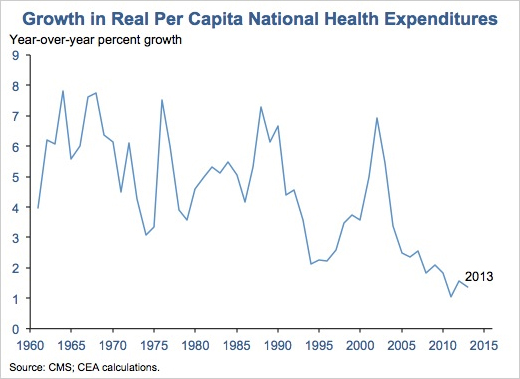
In 2013, the rate of health care spending grew at its lowest rate since 1960, which was when the federal government first began tracking it.  Health care spending added up to $2.9 trillion in 2013, a 3.6 percent increase, or $9,255 per person, from 2012. The next lowest increase was 3.8 percent in 2009, as published in the report in the journal Health Affairs.  Those rates fall within the range of recent low annual growth rates in health care spending, between 3.6 and 4.1 percent from 2009 to 2013.  Spending on health care grew at a similar pace as the economy and reflected 17.4 percent of the gross domestic product, which accounts for the total output of goods and services.

The Obama administration suggests that limits on Medicare payments to hospitals and health maintenance organizations, cuts in federal spending, and the prevalence of high-deductible health insurance plans have contributed to discouraging the use of care by requiring consumers to pay more health costs, and in turn have controlled the growth of health care spending.  However, quicker growth in Medicaid spending offset some of the restraint on Medicare and private insurance spending.  The 2013 statistics did not include the effects of Medicaid expansions that were implemented this year.

120314_cea_1_1

The figures did not answer the question debated by health policy experts: whether the recession or the Affordable Care Act had a hand in the slowdown in health care spending.  The writers of the report asserted that some provisions of the Act “exerted downward pressure” on health spending, while others “exerted upward pressure.”  The report suggests that the key question is whether the growth will accelerate once the economy significantly improves; it is speculated that it will due to historical evidence.

A factor that may have contributed to the slower rate of increase is the retail market of prescription drugs, which amounted to $271 billion in 2013.  This accounted for 9.3 percent of all health spending.  This share of health care spending has not increased significantly recently, due to an increase in use of high-cost specialty medicines and a greater use of low-cost generic drugs.

Additionally, the Affordable Care Act requires federal and state officials to review insurance rates to identify “unreasonable increases in premiums,” and requires insurers to spend at least 80 percent of premium revenue on health care.  The report stated that these provisions contributed to controlling health spending.  Further, the government stated that inpatient and outpatient hospital services were used less in 2013, overlapping with requirements for patients to share more of the cost under some types of insurance.

In conclusion, the report asserted that medical prices increased 1.3 percent last year, which was marginally less than prices in the general economy.  Medical price growth is calculated using the chain-weighted national health expenditures (NHE) deflator for NHE.  Prices for doctors’ services increased less than one-tenth of 1 percent, which amounted for the smallest change since 2002.  Prices for home health care services also declined.  Medicare spending for doctors’ services increased 2.5 percent, while Medicaid spending for these services increased 14.9 percent, essentially because of a short-term increase in payment rates for primary care physicians who were treating Medicaid beneficiaries.  Medicare and Medicaid accounted for more than one-third of all health spending.

The government should continue to impose limits on health spending through different areas of health care to sustain the growth of health spending in the United States, especially while the general economy has yet to recover.  It is important for the government to use its resources wisely when deciding where to allocate them.  As health advocates and the general public realize, it is essential to find a balance between providing high quality medical care while controlling health spending relevant to the general economy.

Pentagon Reviewing Care for Veterans Exposed to Chemical Weapons

An October investigation by the New York Times (NYT) has led the Pentagon to review and adjust how it cares for veterans returning from tours in Iraq who believe they were exposed to chemical weapons.  The NYT investigation notes that between 2004 and 2011, American and American-trained Iraqi troops “repeatedly” found chemical weapons and were even wounded by them on “at least” six occasions.  All told, the report states that 5,000 chemical warheads, shells or aviation bombs were found in that time.  It also noted that secrecy was needed regarding the discoveries.  Secrecy surrounding the missions, however, may have put a number of military service personnel at risk as they were not aware of the threat these old munitions were to their health. Also, they were not allowed to discuss with military doctors the nature of their injuries and thus could not receive the proper treatment.

In 2004, the Army sent out instructions for the treatment of exposed soldiers which included collection and analysis of blood and urine samples for all potentially exposed soldiers followed by annual, long-term follow-up appointments – coordinated by the Deployment Health Clinical Center at Walter Reed Army Medical Center – for those who had indeed been exposed.  In addition, incidents of exposure were to be recorded and reported by Command Surgeons and a database maintained by the US Army Center for Health Promotion and Preventative Medicine.  However, the original NY Times investigation uncovered veterans who were never given blood and urine tests, told their symptoms were from something else, and returned to duty before their symptoms were over.  Furthermore, the long-term care they were promised was never followed up on.

Defense Secretary Chuck Hagel moved quickly to correct these issues.  Shortly after the investigation, which only mentioned 17 American service members that were exposed, he ordered an internal review of Pentagon records, specifically the collection of “post deployment health assessments” held by the Army’s Public Health Command.  In a statement following that review, the Pentagon now says that more than 600 American service members reported exposure to chemical weapons in Iraq according to the surveys filled out by troops returning from combat tours.   In the survey, they specifically ask the question “Do you think you were exposed to any chemical, biological and radiological warfare agents during this deployment?”  The Army surgeon general’s office said that 629 of these surveys were affirmative for this question.

The Army and Navy have both made statements that the examinations promised to long-term veterans will start to be available in early 2015.  Furthermore, because the previous policy of secrecy created a lack of records of exposure, the military will be reaching out to units that were possibly exposed to try and find all of the affected veterans.  Finally, there will be a hotline for veterans to call who believe they were exposed to chemical weapons.  Hopefully as the secrecy fades away and outreach continues – these veterans can get the help they need.