
Category: Blog

Warehouse fire highlights importance of EHR

A warehouse fire in the Williamsburg neighborhood of Brooklyn, NY provided yet another compelling argument for the need for protected health information to be accessible through an Electronic Health Record (EHR) system. The federal government, through the Department of Health and Human Services (HHS), among other entities, have released various statements highlighting the importance of developing EHRs. The fire, which burned a Williamsburg warehouse on January 31, 2015, resulted in innumerable pieces of personal health information (PHI) littering the streets of New York. The fire, which began on a Saturday, still burned on Monday.

According to EHR Intelligence, “recovery specialists [continue to] comb the streets and the East River for fragments of papers with personal health information, social security numbers, and bank account details exposed to the public.” Moreover, EHR Intelligence reports that North Shore-Long Island Jewish Health System, New York-Presbyterian Hospital, NYU Langone Medical Center, and Mount Sinai Health System stored records and patient information at the warehouse. Luckily, all the organizations, according to the New York Times, had copies of the patient records within its respective EHR systems.

Fortunately with responsive recovery teams and on the ground personnel the warehouse fire did not result in a massive breach potentially affecting thousands of patients, but it did illustrate the importance of having effective EHR systems and also the need to store patient data in more than one place. Imagine if any of the health care providers storing data at the warehouse did not have an EHR system. Could you imagine mitigating that situation? What would you tell patients? How would HHS deal with the breach?

The Office of the National Coordinator, within HHS, has numerous resources available to providers to help implement an effect EHR system. Moreover, the ONC provides additional information about the importance of EHR systems to improving patient care. Other than helping to reduce potential breaches, EHR systems are so popular because they help further the goal of interoperability. Interoperability is on the national health care agenda and has support from both Congress and the White House. President Obama’s proposed fiscal year 2016 budget allocates $78 million to ONC, which is a $17 million dollar increase since ONC’s inception, to help further the interoperability mission. Having an effective EHR system helps to promote the interoperability message in that, after the initial interoperable framework is laid by the federal government, it will be crucial for providers to be well equipped with systems that can easily interact with one another. EHR systems allow a patient with various providers to receive more coordinated care. Moreover, EHR systems can make it much less burdensome for individual patients to access their personal health records.

While the weekend warehouse fire is a tell tale example of the necessity for electronic record keeping, the federal government is also invested in the electronic systems to help further an even more important goal: increasing the quality and effectiveness of health care services.
State Politics, Medicaid Expansion, and Public Health

Since the Supreme Court ruled against the Affordable Care Act’s mandatory Medicaid expansion in 2012, twenty-nine states and the District of Columbia have expanded the program to individuals at or below 138% of the Federal Poverty Index (FPI), or approximately $16,000 for an individual per year. Resistance to the expansion has largely come from states with Republican governors and/or legislatures. However, in December, three GOP governors moved to expand Medicaid in their states – Utah, Tennessee, and Texas. Indiana received Federal approval for its Medicaid plan the last week in January. While a big move in support of the President’s signature health care law, the proposals come with drawbacks that may negatively affect the effectiveness of the expansion.

The Utah expansion does not rely on Federal programs to insure its citizens. Adapting the Arkansas expansion plan, the Utah plan allows the State’s citizens to purchase private insurance with Federal funds rather than enrolling in the Federal Medicaid program. Utah’s program will cover nearly 100,000 residents over the next four years. Residents under 100% FPI continue their enrollment in traditional Medicaid while the “expanded” individuals (between 100-138% FPI) receive assistance to purchase private insurance or enroll in an employer-offered plan. The Utah plan touts $15 monthly premiums. However, the plan also poses a $50 penalty for every Emergency Room visit for a non-emergency situation in an effort to bring down health care costs. Notably, this adapted Medicaid expansion had to be approved by the Centers for Medicaid and Medicare Services (CMS).

Tennessee liked the plan behind Utah’s expansion. Medicaid expansion under these terms has been deemed a compromise between Republican and Democratic ideals. Gov. Bill Haslam has specifically stated that his 2015 proposal is not an expansion of the Medicaid program, but the “unveil[ing] of Insure Tennessee.” Early estimates predict that nearly 200,000 Tennesseans will be eligible for State assistance under the proposed expansion. Notably, Tennessean hospitals are largely in favor of the Expansion. The Tennessee Expansion does more than focus solely on making available funds to purchase private insurance, but also shifts bill-payment to an outcome-based method rather than fee-for-service. Representatives in Tennessee on all sides of the Expansion debate support the Governor’s decision to make insurance available through the proposed means. The proposals must still be approved by the Tennessee legislature and CMS.

The biggest potential win for the President’s health law is the state of Texas. Former Governor Rick Perry has been one of the most vociferous opponents of the Medicaid expansion. However, Governor-Elect Greg Abbott addressed the extremely controversial topic with state lawmakers in Houston. Working with CMS to expand Medicare could mean nearly $10 billion in Federal funds for Texas over the coming years. Texas has the most of any state to gain from the Medicaid Expansion. Nearly 950,000 Texans live between 100-138% FPI. The Kaiser Foundation believes these Texans represent approximately twenty-five percent of all Americans living in the “gap.” The Texas legislature has rejected the “traditional” Expansion, but the Governor-Elect’s meetings may indicate an alternative similar to those in Utah and Tennessee, though his office has yet to comment.

The approval of Indiana’s plan may encourage even more states to expand their Medicaid services. The Indiana plans extends coverage to nearly 350,000 low-income individuals and families. The plan requires enrollees to contribute to a health savings account, an effort to keep “personal responsibility” as part of the expansion. However, the plan comes with high penalties for missed payments, including up to six-month exclusions from the program. The plan also increases reimbursement rates, which were cut across the board by the Affordable Care Act. Indiana’s plan has already caught the attention of the Wyoming legislature.

The twenty-two states that are yet to expand the Federal program need to act quickly. The Affordable Care Act only covers 100% of any state’s expansion through 2016, covering only 90% of associated costs thereafter. Understandably, political and ideological differences will hamper Medicaid expansion in many states. However, Utah’s adaptation to the Medicaid expansion may allow well-meaning legislatures to not only follow their ideals but also act in the best interest of their citizens. In Tennessee, for example, the proposal allows the State legislature to provide expanded coverage while encouraging Tennesseans to take an active role and have more personal responsibility for their own health care.

Growth of Health Care Spending at its Lowest

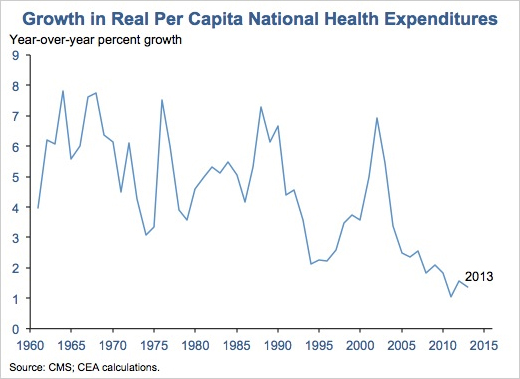
In 2013, the rate of health care spending grew at its lowest rate since 1960, which was when the federal government first began tracking it.  Health care spending added up to $2.9 trillion in 2013, a 3.6 percent increase, or $9,255 per person, from 2012. The next lowest increase was 3.8 percent in 2009, as published in the report in the journal Health Affairs.  Those rates fall within the range of recent low annual growth rates in health care spending, between 3.6 and 4.1 percent from 2009 to 2013.  Spending on health care grew at a similar pace as the economy and reflected 17.4 percent of the gross domestic product, which accounts for the total output of goods and services.

The Obama administration suggests that limits on Medicare payments to hospitals and health maintenance organizations, cuts in federal spending, and the prevalence of high-deductible health insurance plans have contributed to discouraging the use of care by requiring consumers to pay more health costs, and in turn have controlled the growth of health care spending.  However, quicker growth in Medicaid spending offset some of the restraint on Medicare and private insurance spending.  The 2013 statistics did not include the effects of Medicaid expansions that were implemented this year.

120314_cea_1_1

The figures did not answer the question debated by health policy experts: whether the recession or the Affordable Care Act had a hand in the slowdown in health care spending.  The writers of the report asserted that some provisions of the Act “exerted downward pressure” on health spending, while others “exerted upward pressure.”  The report suggests that the key question is whether the growth will accelerate once the economy significantly improves; it is speculated that it will due to historical evidence.

A factor that may have contributed to the slower rate of increase is the retail market of prescription drugs, which amounted to $271 billion in 2013.  This accounted for 9.3 percent of all health spending.  This share of health care spending has not increased significantly recently, due to an increase in use of high-cost specialty medicines and a greater use of low-cost generic drugs.

Additionally, the Affordable Care Act requires federal and state officials to review insurance rates to identify “unreasonable increases in premiums,” and requires insurers to spend at least 80 percent of premium revenue on health care.  The report stated that these provisions contributed to controlling health spending.  Further, the government stated that inpatient and outpatient hospital services were used less in 2013, overlapping with requirements for patients to share more of the cost under some types of insurance.

In conclusion, the report asserted that medical prices increased 1.3 percent last year, which was marginally less than prices in the general economy.  Medical price growth is calculated using the chain-weighted national health expenditures (NHE) deflator for NHE.  Prices for doctors’ services increased less than one-tenth of 1 percent, which amounted for the smallest change since 2002.  Prices for home health care services also declined.  Medicare spending for doctors’ services increased 2.5 percent, while Medicaid spending for these services increased 14.9 percent, essentially because of a short-term increase in payment rates for primary care physicians who were treating Medicaid beneficiaries.  Medicare and Medicaid accounted for more than one-third of all health spending.

The government should continue to impose limits on health spending through different areas of health care to sustain the growth of health spending in the United States, especially while the general economy has yet to recover.  It is important for the government to use its resources wisely when deciding where to allocate them.  As health advocates and the general public realize, it is essential to find a balance between providing high quality medical care while controlling health spending relevant to the general economy.

Pentagon Reviewing Care for Veterans Exposed to Chemical Weapons

An October investigation by the New York Times (NYT) has led the Pentagon to review and adjust how it cares for veterans returning from tours in Iraq who believe they were exposed to chemical weapons.  The NYT investigation notes that between 2004 and 2011, American and American-trained Iraqi troops “repeatedly” found chemical weapons and were even wounded by them on “at least” six occasions.  All told, the report states that 5,000 chemical warheads, shells or aviation bombs were found in that time.  It also noted that secrecy was needed regarding the discoveries.  Secrecy surrounding the missions, however, may have put a number of military service personnel at risk as they were not aware of the threat these old munitions were to their health. Also, they were not allowed to discuss with military doctors the nature of their injuries and thus could not receive the proper treatment.

In 2004, the Army sent out instructions for the treatment of exposed soldiers which included collection and analysis of blood and urine samples for all potentially exposed soldiers followed by annual, long-term follow-up appointments – coordinated by the Deployment Health Clinical Center at Walter Reed Army Medical Center – for those who had indeed been exposed.  In addition, incidents of exposure were to be recorded and reported by Command Surgeons and a database maintained by the US Army Center for Health Promotion and Preventative Medicine.  However, the original NY Times investigation uncovered veterans who were never given blood and urine tests, told their symptoms were from something else, and returned to duty before their symptoms were over.  Furthermore, the long-term care they were promised was never followed up on.

Defense Secretary Chuck Hagel moved quickly to correct these issues.  Shortly after the investigation, which only mentioned 17 American service members that were exposed, he ordered an internal review of Pentagon records, specifically the collection of “post deployment health assessments” held by the Army’s Public Health Command.  In a statement following that review, the Pentagon now says that more than 600 American service members reported exposure to chemical weapons in Iraq according to the surveys filled out by troops returning from combat tours.   In the survey, they specifically ask the question “Do you think you were exposed to any chemical, biological and radiological warfare agents during this deployment?”  The Army surgeon general’s office said that 629 of these surveys were affirmative for this question.

The Army and Navy have both made statements that the examinations promised to long-term veterans will start to be available in early 2015.  Furthermore, because the previous policy of secrecy created a lack of records of exposure, the military will be reaching out to units that were possibly exposed to try and find all of the affected veterans.  Finally, there will be a hotline for veterans to call who believe they were exposed to chemical weapons.  Hopefully as the secrecy fades away and outreach continues – these veterans can get the help they need.

FDA “Updates” Its Policy on Blood Donations from Gay and Bi-Sexual Men Engaging in Same-Sex Intercourse

Since 1983, FDA has banned men from donating blood for life if they have had sex with another man, even just once, at any point from 1977 and on, Despite lacking scientific significance, the lifetime ban has remained in effect until this past December. However, organizations like the Red Cross have been pushing for the ban to be revisited since 2006. On December 23, 2014, the FDA announced that it would alter the 31-year old national policy banning males who engage in same sex intercourse from donating blood. The new proposed policy would now allow males who are gay or bi-sexual to donate blood so long as the potential donor has abstained from same-sex intercourse for at least 12 months.

Politicians, gay rights activists, and public health officials have spoken out against FDA’s new policy and some are calling the ban “harmful and offensive.” According to Gay Men’s Health Crisis (GMHC), requiring gay and bi-sexual men to abstain from having sex with other men for a year ”is [still] a de facto lifetime ban.” GMHC went on to note that heterosexual men are not required to remain celibate for a year and therefore, the “step forward” that FDA is attempting to make is still overt discrimination.

Senator Tammy Baldwin (D-Wisc.), who led the charge for the government to end the lifetime ban, noted that although the new proposal was a step in the right direction, she “remain[s] concerned that [the new policy] does not achieve our goal of putting in place a policy that is based on sound science.” Baldwin noted, “[t]he Administration must continue to work toward implementing blood donation policies based on individual risk factors instead of singling out one group of people and turning away healthy, willing donors, even when we face serious blood shortages.”

Despite receiving criticism and concerns, the FDA’s new proposed policy garnered support as well. Steven W. Thrasher, for NPR’s Code Switch, a gay male who has written extensively about FDA’s lifetime blood ban, offered his support for the recently updated policy. Throughout Thrasher’s piece, he explained the technicalities and reasoning behind the ban, from his perspective, noting that because “the act of a man having sex with another man imposes a risk on his potential blood donation on the same level as taking IV drugs, having been incarcerated, or having had sex with someone who is an IV drug user or has been incarcerated, Thrasher is “okay” with the update on the ban.

Thrasher explained that there is a difference between “shaming gay men” and recognizing that the practice of homosexual male sex does have actual risks proven by various demographics. Thrasher cites statistics from the CDC, noting “the overall gay male population of the US is only 2%, according to the CDC, this group “accounted for three-fourths of all estimated new HIV infections annually from 2008 to 2010.” Thrasher said, “A one-year ban, however, would be based on the risk assessments of a practice — the practice of a man having sex with another man — and not unscientifically shaming gay men. This might sound like a fine difference. But it’s an important one.”

Others believe that the government should adopt the approach followed in Italy and Spain, where gay or bi-sexual men, engaging in sex with other men are allowed to donate blood so long as the donor is in a monogamous relationship and whose blood tests are safe. The “individualized risk assessment” approach appears to be successful in Italy, and according to a 2013 study, there is “no evidence of a significant impact on the human immunodeficiency virus epidemic in Italy.”

Whether you view the updated policy as a baby-step, a leap forward, or as no change at all, FDA’s recent announcement has undoubtedly reignited the conversation about blood donations polices and the still stigmatized health concerns of gay and bi-sexual men.

ICE Detainee Facility Medical Treatment

The medical standard at Immigration and Customs Enforcement (ICE) detention facilities has become highly contested as more detainees are coming forward. In 1995, there were 6,785 immigrants being detained nationwide. As of 2013, this number rose to 34,000. Additionally, the annual cost to detain immigrants is above 2 billion according to the National Immigration Forum. However, the increasing number of detainees and the hefty cost of funding is not positively reflected in the medical treatment afforded this group. As the number of detainees continues to rise, concerns about medical treatment follow.  Because ICE detention facilities do not have effective or enforceable health standards, detainees are being denied necessary and sometimes emergency medical care.

Although ICE officials have agreed to provide immigration detainees with constitutionally adequate levels of medical care, they have fallen short of this goal. Instead, detainees are faced with issues such as waiting weeks or months to receive medical treatment and dealing with great distances between the facility and urban areas (making trips to hospitals or physician specialists difficult). The Detention Watch Network has noted that, out of the 250 detention centers none can guarantee basic medical care. Because of these standards, a detainee did not receive the proper medication or treatment for his type 2 diabetes.  As a result, his health quickly deteriorated and he suffered kidney damage, a heart attack, and he eventually went blind.

Currently, many cite the due process clause, the 2000 National Detention Standards (NDS), and the 2008 Performance Based National Standard as governing law for medical treatment standards within ICE detention facilities.

Under the due process clause, immigration detention is not a part of the criminal justice system. Therefore, detainees are not entitled to the full panoply of due process rights afforded criminal defendants. Also, detainees are not serving time; instead they are a part of the removal process to determine deportation. The aim of their placement in these facilities is to prevent immigrants from absconding during their immigration proceedings.

The 2000 (NDS) is the initial governing principle for the medical treatment of detainees. The NDS states, “immigrants in all facilities must have access to medical services that promote detainee health and general well-being, including initial medical screenings for mental illnesses within the local community”.

The standard was expanded in 2008 to include a performance-based format. This format would ensure access to medical treatment. Specifically, this would mean that detainees have the right to “access to emergent, urgent, or non-emergent medical care and access to mental healthcare within the Division of Immigration Health Services (DIHS).” The hope was that the expansion will ensure that detainee health care needs are met in a timely and efficient manner.

Unfortunately, the 2000 NDS was not very enforceable. Although it claimed to protect a detainee’s medical needs, in practice, it did very little. This standard prompted detainees to fill out medical attention slips; however, filling out the slip did not guarantee: (1) that the detainee would be seen by a physician, (2) that if care was received the medical issue would be solved, (3) that the detainee was guaranteed a follow up appointment, or (4) that the detainee may ask for a second opinion if he/she disagreed with the physician’s suggestions. Not only was the process to receive medical attention uncertain, but medical screenings were delayed as well. Medical screenings covered exams for determining potential mental problems and suicide risks. These screenings are done for imminent health problems that are.  However, under the 2000 NDS standard it could take up to two weeks before a detainee was confirmed to have a mental ailment or suicidal thoughts after being examined. This also applied to detainees who had been pre-diagnosed and who had received treatment prior to entering into the facility. In sum, the 2000 NDS resulted in unfavorable outcomes and delays.

These inefficiencies were addressed in the 2008 expansion. For example, the wait to hear back about a medical request once the medical attention slip was completed decreased from several weeks to 48 hours. However, this change was only implemented in facilities that choose to allow detainees to fill out medical attention slips. Additionally, medical exams for mental disorders and suicide risks were similarly enforced. A DHS report on five facilities found that only one complied with the health screening requirement and only three complied with the physical exam requirement. Therefore, these 2008 changes would only be effective in facilities that choose to enforce these new standards.

In sum, the conditions in ICE detention facilities in terms of medical treatment are far from feasible. The amount of deaths that arise from negligence and delays in medical care show how the healthcare system has failed some of the most vulnerable among us.